Contribution margin: the number that decides what to sell more of
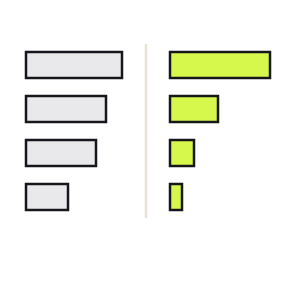
Ask which of your products is most profitable and most people reach for gross margin percentage. It is the wrong tool for the question, because the decision you are actually making is not "which product is best" but "what should I sell one more of."
Contribution margin answers that. It is revenue minus the costs that genuinely vary with the sale — and it is what is left to cover every fixed cost you have before anything becomes profit.
Percentage and dollars answer different questions
This is where most of the confusion lives. A product with a 70% margin sounds better than one with 40%, but if the first sells for $20 and the second for $600, one more sale of the second contributes $240 against $14.
Which is right depends on what constrains you. If your limit is customers or demand, the dollars matter and you want the $240. If your limit is cash, capacity, or shelf space, the percentage and the velocity matter, because you can turn the cheap one over many times.
| Product | Price | CM % | CM $ |
|---|---|---|---|
| A · standard unit | $120 | 58% | $70 |
| B · installed system | $2,400 | 31% | $744 |
| C · service plan | $480 | 52% | $250 |
| D · accessory | $28 | 72% | $20 |
The constraint decides the ranking
Every business has one thing that runs out first. Machine hours, van capacity, skilled labour, retail floor space, your own time. Whatever it is, the right measure is contribution per unit of that constraint — not per sale.
A job contributing $744 that occupies your only installer for three days earns $248 a day. A $250 service plan taking two hours earns far more per hour of the same person. If installers are your bottleneck, the service plan wins despite contributing a third as much per sale, and no amount of looking at margin percentages will show you that.
Installed system
$248
contribution per installer day
Service plan
$1,000
per installer day
The constraint
1
installer, fully booked
What counts as variable is a judgment call
Materials and commissions are obviously variable. Rent is obviously not. The middle is where the analysis gets decided, and the honest test is whether the cost changes if you sell one more unit this month — not whether it changes eventually.
A salaried technician is fixed in the short run even though labour feels variable. Delivery is variable. Machine depreciation is fixed no matter how much you run it. Get this wrong in the direction of counting fixed costs as variable and you will decline profitable work, because every sale will look thinner than it is.
Free · no account · no card
Get your 2027 budget built from your QuickBooks — P&L, balance sheet and cash flow, in Excel.
Where it changes decisions
- Taking marginal work. A job priced below full cost but above variable cost still contributes to overhead you are paying anyway. If capacity is idle, it beats an empty slot — provided it does not displace better work or reset your pricing.
- Discounting. A discount comes straight out of contribution. At a 31% CM, a 10% discount removes nearly a third of what the sale contributes.
- Product mix. Shifting sales toward high-contribution lines raises profit with no revenue growth at all — usually the cheapest profit improvement available.
- Break-even. Fixed costs divided by contribution margin. Which means a mix shift changes your break-even without anyone touching a cost.
The one habit worth building
Compute contribution margin per unit of your constraint, once, for your main products or job types. Most businesses have never done it and are genuinely surprised by the ranking — the thing everyone assumes is the flagship often turns out to be occupying the bottleneck for a modest return.
You do not need to redo it monthly. Do it annually, and again whenever prices or costs move materially, and let it inform what sales actually pushes.
Need your financials for a lender, a buyer or your accountant? Get the free financials pack →
See what an AI CFO says about your own numbers.
$99/mo, everything included. Free for 14 days, no card.