Churn is a cash problem before it's a growth problem
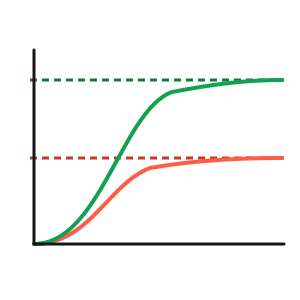
Churn gets discussed as a growth metric — the leak in the bucket that slows you down. That framing understates it. Churn is first a cash problem, because you paid to acquire every customer who leaves, and if they leave before they have repaid that cost, you funded a loss.
Which means churn does not just slow growth. Past a certain rate, growth actively consumes cash, and the faster you grow the faster you run out.
The payback window is where it bites
Say you spend $420 to acquire a customer who pays $95 a month at a 70% contribution margin. Each month they contribute about $67, so you recover the acquisition cost in roughly six and a half months.
Everything depends on whether they stay that long. At 3% monthly churn the average customer lasts about 33 months and you make five times your money. At 10% they last 10 months — still profitable, but you have waited two-thirds of their life just to break even. At 15% the average customer leaves at month seven, barely past payback, and every new customer you acquire is a cash outflow with almost no return.
| Monthly churn | Avg. lifetime | Lifetime value | LTV:CAC |
|---|---|---|---|
| 3% | 33 months | $2,211 | 5.3x |
| 5% | 20 months | $1,340 | 3.2x |
| 10% | 10 months | $670 | 1.6x |
| 15% | 7 months | $469 | 1.1x |
The ceiling nobody calculates
Here is the part that surprises people. Churn sets a hard maximum size for your business, regardless of how good your sales team is.
If you add 40 customers a month and lose 5% of your base each month, you stop growing when 5% of the base equals 40 — at 800 customers. Not because sales failed, but because losses caught up with additions. To get past it you must either add more or lose fewer, and improving retention is almost always the cheaper of the two.
At 5% churn
800
ceiling, adding 40/month
At 3% churn
1,333
same sales effort
Growth needed to match
+67%
more new customers, every month
Cutting churn from 5% to 3% raises the ceiling by two-thirds. Achieving the same thing through acquisition would mean permanently increasing new customers by 67% — and paying CAC on every one of them. Retention work has no CAC attached, which is why it is nearly always the higher return.
Free · no account · no card
Get your 2027 budget built from your QuickBooks — P&L, balance sheet and cash flow, in Excel.
Gross churn and net churn are different questions
Gross churn is what you lost. Net churn subtracts expansion — upgrades, added seats, larger orders — from those losses. A business can lose 4% of revenue to cancellations and gain 5% from existing customers spending more, giving negative net churn: revenue grows with no new customers at all.
Track both, because they prescribe different work. Rising gross churn is a product, onboarding, or fit problem. Weak expansion is a pricing and packaging problem. Watching only the net number lets a genuine retention problem hide behind good expansion for a year.
Most churn is decided early
Cohort curves in almost every repeat-purchase business look the same: a steep drop in the first weeks, then a long flattening. Customers who reach month three tend to stay much longer.
That concentrates the opportunity. Onboarding, first-week activation, and whatever your product's moment of obvious value is — that is where retention is actually won. Win-back campaigns aimed at people who left months ago are working on the flattest, least responsive part of the curve.
So measure by cohort, not in aggregate. A blended churn rate mixes customers acquired under different offers, channels, and versions of the product, and it will happily stay flat while the newest cohorts quietly get worse.
Need your financials for a lender, a buyer or your accountant? Get the free financials pack →
See what an AI CFO says about your own numbers.
$99/mo, everything included. Free for 14 days, no card.