Prepaid, accrued, deferred: the three entries that fix your P&L
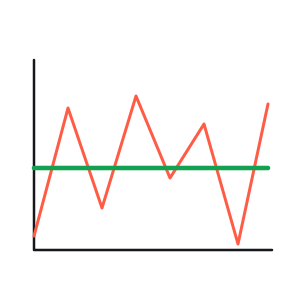
Look at twelve months of net income and you will probably see a sawtooth. January is terrible, February is great, June is terrible again. Sales were steady the whole time. Nothing about the business explains it.
What explains it is that your annual insurance premium landed in January, a bonus was paid in June, and a customer prepaid for a year of work in February. Each of those is a cash event that got recorded as if it were an earning event, and the profit line absorbed the shock. Three adjusting entries fix nearly all of this, and once you understand what they are for, they stop feeling like accounting trivia.
Prepaid: you paid early
You wrote a $14,400 check in January for twelve months of insurance. You have not consumed twelve months of insurance — you have consumed one. The other eleven months are something you own: coverage you have paid for and not yet used.
So it goes on the balance sheet as a prepaid asset, and $1,200 moves to the P&L each month as the coverage is actually used up. January stops looking like a disaster and every month carries its fair share.
| Expensed in January | Treated as prepaid | |
|---|---|---|
| January expense | $14,400 | $1,200 |
| January net income | -$12,200 | $2,200 |
| Feb–Dec expense (each) | $0 | $1,200 |
| Feb–Dec net income (each) | $3,400 | $2,200 |
| Full-year net income | $25,200 | $25,200 |
Accrued: you owe but have not paid
The mirror image. Your team earned a $9,000 bonus over six months and you pay it in June. The cost belongs to the six months in which the work happened, not to June.
An accrual records the expense as it is incurred and parks the unpaid amount as a liability — $1,500 a month of expense, building a balance you owe. When June's payment goes out it clears the liability and never touches the income statement at all, because the expense was already taken.
The same logic covers anything you have received but not yet been billed for: the contractor who invoices next month for work done this month, utilities in arrears, the accountant's year-end fee. If the value was consumed in the period, the expense belongs in the period.
Deferred: they paid you early
A customer sends $24,000 in February for a year of service. That money is in your account and it is emphatically not revenue — you have not done the work yet. It is deferred revenue: a liability, an obligation to deliver.
Two thousand dollars becomes revenue each month as you actually earn it. Book the full $24,000 in February and you have reported a spectacular month, set a benchmark you cannot repeat, and hidden the fact that you now owe eleven months of work you have already been paid for.
Cash received
$24k
February
Revenue in February
$2k
one month earned
Deferred revenue
$22k
a liability, not income
This one has a cash consequence people miss. Deferred revenue is a wonderful source of working capital — customers are funding you interest-free — but the obligation is real. Spend the cash as though it were profit and you will find yourself delivering a year of work with no money left to deliver it with.
Free · no account · no card
Get your 2027 budget built from your QuickBooks — P&L, balance sheet and cash flow, in Excel.
Where to draw the line
You do not need to do this for every $60 subscription. Set a threshold — many small businesses use something like $1,000 and a period spanning more than one month — and only adjust items above it.
In practice a short list covers almost everything: insurance premiums, annual software renewals, retainers and deposits received, bonuses and commissions, prepaid rent, and any customer who pays for more than a month at a time. Half a dozen recurring items, handled the same way every month.
Why it is worth the ten minutes
These entries are the difference between a P&L that reports what happened and one that reports when money moved. Without them you cannot tell a bad month from an unlucky one, you cannot compare month to month, and every trend you think you see may be an artifact of billing timing.
With them, the sawtooth flattens out and what is left is signal. That is the entire point of accrual accounting, and these three entries are where most of the benefit actually lives.
Need your financials for a lender, a buyer or your accountant? Get the free financials pack →
See what an AI CFO says about your own numbers.
$99/mo, everything included. Free for 14 days, no card.