Seasonality: planning a business with an uneven year
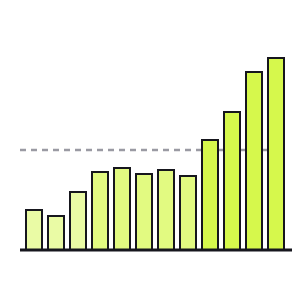
Divide the year by twelve and you get a number that describes no actual month of a seasonal business. Yet that average quietly underpins most planning: the monthly budget, the hiring plan, the sense of whether things are going well.
For a landscaper, a ski shop, a tax practice, a wedding venue or a toy brand, the average month is a fiction. Planning against it produces panic in the trough and complacency at the peak.
Build the index before you build the budget
Take three years of monthly revenue, express each month as a percentage of its year's total, and average those percentages across the three years. That gives you a seasonal index — the shape of your year, separated from its size.
Three years matters. One year is anecdote; two cannot tell you whether an odd month was seasonal or a one-off. Once you have the shape, next year's budget is one decision (how big) applied to a pattern you already know (what shape).
| Month | Share of year | vs even twelfth |
|---|---|---|
| January | 3.4% | −4.9 pts |
| February | 3.1% | −5.2 pts |
| March | 5.8% | −2.5 pts |
| April–August | 31.2% | roughly even |
| September | 9.1% | +0.8 pts |
| October | 12.4% | +4.1 pts |
| November | 16.8% | +8.5 pts |
| December | 18.2% | +9.9 pts |
Judge a month against its own history
The practical payoff is that you stop misreading months. February at $47,000 is not a disaster if February is a 3.1% month in a $1.5m year — it is exactly on plan. December at $210,000 is not a triumph if December should be 18.2% of $1.5m.
So compare each month to the same month last year, and to its seasonal expectation. Sequential comparisons — this month versus last — are close to meaningless in a seasonal business, and they are what most dashboards default to.
Free · no account · no card
Get your 2027 budget built from your QuickBooks — P&L, balance sheet and cash flow, in Excel.
Fixed costs do not know it is February
This is the whole difficulty. Revenue is seasonal; rent, insurance, salaried staff and loan payments are not. Your cost base runs flat through a revenue curve that does not, which means the business is structurally loss-making for part of every year and must earn enough in the peak to cover it.
Two consequences follow. First, your break-even is annual, not monthly — a monthly break-even calculation will tell you that you are failing for five months a year. Second, the peak has to be protected fiercely, because there is no second chance at it. A bad December for a December business is not a bad month; it is a bad year.
Cash is the real constraint
Seasonal businesses fail in the trough while being perfectly profitable annually. The cash from the peak has to fund the quiet months, which means the discipline is not earning it but keeping it.
- Forecast the trough, not the year. Find the lowest projected balance and the week it happens. That single number is what determines whether the plan is survivable.
- Arrange credit at the peak. A line of credit is easiest to get when the numbers look best, which is exactly when you least feel the need for one.
- Ring-fence the peak's cash. The most common failure is treating a strong December as profit and distributing it, then meeting February with nothing.
- Flex what you can, honestly. Seasonal or contract staffing genuinely helps. Just be realistic about what is actually variable — the skilled people you need in the peak are rarely re-hirable on demand.
See what an AI CFO says about your own numbers.
Meet your AI CFO →