Your year-end close starts in October
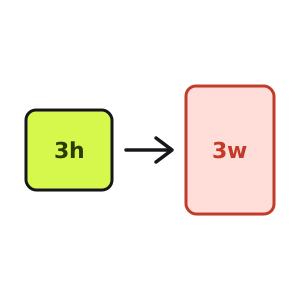
A year-end close is rarely hard because December was complicated. It is hard because eleven months of small unresolved things arrive at once, during the busiest trading period of the year, in front of a deadline.
Almost all of that is October work. The difference between a January that takes three days and one that takes three weeks is decided now, while there is still time to chase people and fix things.
Clean the balance sheet, not the P&L
Everyone reviews the income statement because that is where the interesting numbers live. Year-end problems almost always come from the balance sheet instead, because it is cumulative: an error from March is still sitting there in December, quietly wrong.
Go account by account and ask one question of each: can I prove this balance? Bank and card accounts should tie to statements. A/R and A/P should tie to the aging reports. Inventory should tie to a count. Anything you cannot explain in a sentence is something you will be explaining to your accountant in January, at their hourly rate.
| Account | Prove it with | Typical finding |
|---|---|---|
| Bank and cards | Reconciliation to statement | Stale uncleared items |
| A/R | Aging report | Invoices nobody will pay |
| A/P | Aging report | Duplicated bills |
| Inventory | A physical count | Book vs. actual gap |
| Undeposited funds | Should be near zero | Payments recorded twice |
| Suspense / ask-my-accountant | Should be zero | Unanswered questions |
| Loans | Lender statement | Principal and interest never split |
Chase the receivables while the year still matters
An invoice from June that is still open in October is unlikely to be paid by simply waiting longer. October is the last comfortable moment to pursue it properly, and it is also when the customer still has budget.
Work the aging oldest first, and be honest about what is collectible. Anything genuinely uncollectible should be written off deliberately, in the year it went bad, rather than carried into next year as a receivable everyone knows is fiction. That decision belongs to you in October, not to your accountant in February.
Get the awkward questions answered now
Every set of books has a handful of items nobody has decided about: the equipment purchase that might be capitalised, the owner transfer that might be a distribution, the deposit that might be revenue.
These sit unresolved because each needs a decision rather than a keystroke. Make a list and take it to your accountant in October, as one conversation. The same list surfacing in January becomes a series of emails during their busiest month, each one blocking the close.
October
3hrs
to front-load the work
January, if you don't
3wks
chasing eleven months at once
Suspense account
$0
the target before year end
Free · no account · no card
Get your 2027 budget built from your QuickBooks — P&L, balance sheet and cash flow, in Excel.
Look at the tax position while you can still change it
By January the year is closed and your options are gone. In October you still have a quarter to act on what the numbers are telling you.
Run a rough projection of full-year profit and take it to your accountant. Decisions that only exist before December 31 — timing an equipment purchase, accelerating or deferring income, funding a retirement contribution, adjusting your owner compensation split — all need a few weeks of lead time and a number to reason about.
Then make December boring
If October goes well, December is a normal month close plus a count. That is the goal: not a heroic year-end effort, but an ordinary one, because everything that could have gone wrong was found while there was still time to fix it.
Book the time now — three hours in October, an hour with your accountant, and a plan for the count. It is the highest-return calendar entry in the fourth quarter.
Need your financials for a lender, a buyer or your accountant? Get the free financials pack →
See what an AI CFO says about your own numbers.
$99/mo, everything included. Free for 14 days, no card.