How to read your cash flow statement like a CFO (in ten minutes)
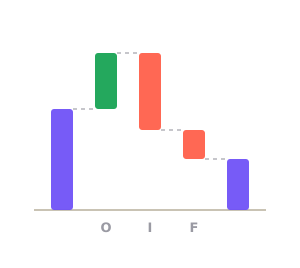
Of the three financial statements, the cash flow statement is the one owners skip — and the one a CFO trusts most. The income statement can flatter you with a profit you haven't collected; the balance sheet is a snapshot frozen on one day. Cash is the truth serum. Money either moved or it didn't, and this statement is the only place that shows you where every dollar actually went.
Here's the ten-minute read. It's the third of a set, alongside reading the income statement and the balance sheet: the P&L says whether you made money, the balance sheet says whether you can keep going, and the cash flow statement says whether you actually have it — and what happened to the rest.
The one rule: follow the cash into three buckets
Every dollar that moved in or out of the bank lands in one of three sections, and the whole skill is reading them separately:
- Operating — cash from actually running the business: sales collected, minus the bills, payroll, and rent paid. This is the engine.
- Investing — cash spent (or raised) on long-term assets: equipment, vehicles, a buildout. Growth money.
- Financing — cash from the outside: loans and lines of credit drawn or repaid, money the owner put in or took out.
Add the three and you get the net change in cash — and it has to equal the difference between last period's bank balance and this one's. It always ties. That's what makes this statement honest.
| Line | Amount |
|---|---|
| Net income | $293,000 |
| + Depreciation & amortization | $120,000 |
| − Increase in receivables | −$220,000 |
| − Increase in inventory | −$170,000 |
| + Increase in payables | $152,000 |
| Operating cash flow | $175,000 |
| Equipment & vehicles purchased | −$240,000 |
| Investing cash flow | −$240,000 |
| Line of credit drawn | $230,000 |
| Term-loan principal paid | −$120,000 |
| Owner distributions | −$200,000 |
| Financing cash flow | −$90,000 |
| Net change in cash | −$155,000 |
Question 1: Does the business actually generate cash?
Go straight to operating cash flow— the subtotal at the end of the first section. This is the single most important number on the statement: the cash the business threw off from just being itself, before any equipment purchases or financing. A healthy company's operating cash flow is positive and roughly tracks profit over time. If it's negative while you're booking a profit, stop — that's the alarm, and Question 2 is why.
Question 2: Why isn't it the same as profit?
The section starts at net income and then adjusts its way to cash, and the adjustments are the story. Depreciation gets added back (it's a real expense but no cash left the bank this month). Then come the working-capital swings, and this is where profitable companies get into trouble:
- Receivables went up? Subtract it — you booked the sale but the cash is still sitting in a customer's account.
- Inventory went up? Subtract it — the cash is on your shelves.
- Payables went up? Add it — you're holding onto cash by paying suppliers later.
In the figure above, $293K of profit became only $175K of operating cash, because a growing business tied $238K net into receivables and inventory. That gap — profit you earned but didn't collect — is the whole subject of profitable but broke, and it lives in the working-capital lines right here.
Question 3: What are you spending to grow?
The investing section is almost always negative, and that's usually a good sign — it means you're putting money into the business: equipment, vehicles, a new location. What you're checking is whether it's deliberate. A big investing outflow the same year cash got tight deserves a hard look: capacity you built ahead of the demand can be exactly what drained the account. Set it next to operating cash flow — are operations funding the growth, or is something else?
Free · no account · no card
Get your 2027 budget built from your QuickBooks — P&L, balance sheet and cash flow, in Excel.
Question 4: Who's funding the gap?
Financing shows where outside money came in or went out — and it's the tell for a business outrunning its own cash. A line of credit being drawn, new debt, or the owner putting money in are all inflows that plug a gap operations couldn't cover. That's fine for a season; it's a warning as a pattern. Read it against operating cash: a company whose growth is funded by its own operations is on solid ground, one funded by a revolver that never gets paid down is renting its runway.
| Step | Cash |
|---|---|
| Beginning cash | $315,000 |
| Operating | +$175,000 |
| Investing | −$240,000 |
| Financing | −$90,000 |
| Ending cash | $160,000 |
Question 5: The one number almost nobody looks at
Operating cash flow minus what you spent on equipment is free cash flow — the cash the business actually generated after keeping itself running and invested. It answers the question the other statements dodge: after everything it takes to operate and grow, is there money left? Here it's $175K minus $240K, or −$65K — the business ran a small free-cash-flow deficit, covered by the line of credit. One quarter, fine. Every quarter, that's a business that can't self-fund, and it's the number a lender or buyer looks at first.
Operating cash flow
$175K
The engine — cash from operations
Free cash flow
−$65K
After equipment spend
Net change in cash
−$155K
What the bank balance did
Read it next to the other two
The cash flow statement only tells its whole story in company. Put it beside the P&L and you see the gap between profit and cash; beside the balance sheet and you see the receivables and inventory those operating adjustments came from. That triangulation is the entire job — the three layers of a CFO — and it's why no one number, read alone, ever tells you the truth.
Need your financials for a lender, a buyer or your accountant? Get the free financials pack →
See what an AI CFO says about your own numbers.
$99/mo, everything included. Free for 14 days, no card.
Prefer to run the numbers yourself? Try the free 13-Week Cash Flow Forecast — it’s free.