The three layers of a CFO
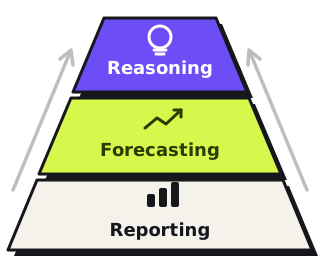
Picture hiring a CFO and you picture one person doing one job: handling the finances. Sit beside a good one for a month, though, and the job splits cleanly into three — three different kinds of work, done in a deliberate order. Reporting, forecasting, and thinking. What happened, what's about to happen, and what to do about it.
The order isn't decoration — it's a stack. Each layer stands on the one beneath it: you can't forecast on books you don't trust, and you can't think clearly without a forecast. Most owners live on the bottom step and reach for the top one anyway, making big calls straight off raw statements. Here's the whole stack, and where Wauvel sits on it.
Layer one — Reporting: what happened
Reporting is the backward-looking layer: taking a month of raw books and turning it into something a human can actually read. Not the data — the read on the data. "Operating income $460,000" is data. "Expenses grew slower than sales, so margin widened as you scaled" is reporting.
This is the foundation, and the part most owners assume they already have because QuickBooks is open in a tab. But a pile of statements isn't reporting any more than a pile of lumber is a house. Reporting is the finding built on top — the three vital signs pulled to the front, every line set against the same month a year ago, the one sentence that says what the month actually meant.
Gross margin
40.0%
Steady — COGS held at 60% of sales
Days to get paid
61days
Longer than a year ago
Current ratio
1.99×
Down from 3.08 a year ago
In Wauvel, this layer is the monthly report itself — your P&L, balance sheet, and cash flow read in plain English, with the levers called out by name. It's the first layer of Wauvel CFO, and it's where every other layer has to start. For the full tour, see what's actually in your monthly report.
Layer two — Forecasting: what's about to happen
Reporting closes the books on a month that's already over. Forecasting is where decisions actually live, because every decision is about the future. It's the same statements turned forward: how many payrolls are in the bank, what's coming due and when, what 30% growth does to your cash long before it does anything to your profit.
And forecasting isn't fortune-telling — it's surprise-removal. Almost every small-business cash crunch is a known event that simply arrived unscheduled: the quarterly tax bill, the slow-paying season, the restock you make months before it pays you back. A forecast doesn't predict the weather so much as tell you to bring a coat.
| Cash in | Cash out | Projected cash | |
|---|---|---|---|
| Today | — | — | $160,000 |
| Month 1 | +$455,000 | −$525,000 | $90,000 |
| Month 2 | +$480,000 | −$470,000 | $100,000 |
| Month 3 | +$520,000 | −$450,000 | $170,000 |
Notice what the snapshot misses. This business shows a healthy 1.99 current ratio, yet it still walks through a month where the account dips near $90K. That gap — between "solvent on paper" and "tight on a Tuesday" — is the entire reason the forward view exists. Every Wauvel report already leans into it, stating your cash cycle in days and flagging what growth will cost you; the cash forecast extends that into a week-by-week runway and a calendar of every dollar landing and leaving.
Free · no account · no card
Get your 2027 budget built from your QuickBooks — P&L, balance sheet and cash flow, in Excel.
Layer three — Thinking: so what, and what now
Reporting and forecasting put the board in front of you. Thinking is the move. It's the layer everyone wants and nobody automates well, because it isn't arithmetic — it's judgment: which lever to pull first, which recommendation to ignore, what to ask before you sign. A number tells you receivables hit 61 days. Thinking tells you to call your biggest late account before you call the bank.
This is what a real CFO is actually for — not the spreadsheet, the sentence after it. "Here's what I'd do, here's what I'd watch, and here's the question I'd want answered before we commit." It has to stay a conversation, too, because the right move usually depends on things the statements don't know yet.
In Wauvel, the thinking shows up twice. Every report ends with ranked, dollar-quantified recommendations and the questions a CFO would raise next — that's included in Wauvel CFO, and so is the open conversation that follows: push back, run a what-if, ask the same thing three ways until it clicks. It stays honest about its limits, too — when a question crosses into tax or legal, it points you to your CPA.
The layers only work as a stack
Go back to the order, because it's the whole point. Thinking built on a forecast you don't have is just a strong opinion. A forecast built on reporting you don't trust is fiction with decimal places. And reporting nobody reads is a filing cabinet. The value compounds upward — which is also why skipping steps fails so reliably.
It's worth being honest about where most owners actually stand:
- Layer zero — raw statements. The books are clean but unread. You have data, not reporting.
- Layer one — you read the report, nod, and file it. Better, but it's a rear-view mirror.
- Layer two — you know your runway and what's coming. Now the numbers inform decisions instead of just recording them.
- Layer three — you argue with the numbers before you act. That's having a CFO, whatever the title on the chair.
Most software sells you a glossier layer one — another dashboard — and lets you call it a finance function. The dashboard was never the hard part. The climb from "I have the data" to "I know what to do" is the hard part, and it's the only part worth paying for.
Need your financials for a lender, a buyer or your accountant? Get the free financials pack →
See what an AI CFO says about your own numbers.
$99/mo, everything included. Free for 14 days, no card.