Sales tax isn't revenue: the number that fools every online seller
Open your store's dashboard and there's a big, satisfying number at the top: total sales. It feels like the score. It is not — because a slice of it was never yours. Every time a customer checks out, you collect sales tax on top of the price, and that tax is money you're holding for the state, not money you earned. Leave it baked into your "revenue" and you've just told yourself the business is bigger, fatter, and more flush than it actually is.
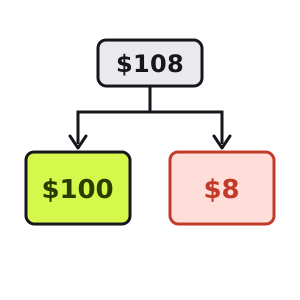
Let's make it concrete and carry one order all the way through. A customer buys $100 of product from your store. Your rate is 8%, so the checkout adds $8 of sales tax and charges the card $108. That $108 hits your bank account as one clean deposit — and that single deposit is where the whole mix-up begins.
What the customer pays isn't what you earned
Three different numbers are hiding inside that one $108, and they belong in three different places. Pull them apart:
Charged to the card
$108
one deposit in your bank
Your revenue
$100
what you actually earned
Owed to the state
$8
a liability, not income
Only the middle number is yours. The $8 is a pass-through — you're the state's temporary cashier, collecting the tax at the register and handing it over when the return comes due. It never earned you anything, it never touches your margin, and it will leave your account again on its way to the tax authority. Book the full $108 as revenue and you've overstated your top line by 8% on every single order.
| The one deposit | Amount | Where it belongs |
|---|---|---|
| Product subtotal | $100.00 | Revenue (income statement) |
| + Sales tax (8%) | $8.00 | Sales tax payable (liability) |
| = Charged to customer | $108.00 | One bank deposit |
Where it lives in your books
Sales tax collected has a home, and it's not the income statement. It's a liability account — usually called Sales Tax Payable — that sits on the balance sheet next to the other things you owe. Money flows into it every time you make a taxable sale, and flows out when you remit to the state. In between, it's a balance you're carrying, not income you're keeping. Booked correctly, that one $108 deposit splits into two:
| Account | Right way | The classic error |
|---|---|---|
| Cash (bank) | +$108.00 | +$108.00 |
| Revenue | +$100.00 | +$108.00 |
| Sales tax payable | +$8.00 | $0.00 |
| Revenue overstated by | $0.00 | $8.00 |
The error looks harmless in the moment — the cash tied out, the deposit cleared, nothing bounced. But it posts the tax to sales instead of to the liability, so the state's $8 gets counted as your income. Do that a few thousand times and your books tell a story that's off by tens of thousands of dollars. When you finally remit, a lot of shops then plug the payment straight to an expense — so now the tax has hit the P&L twice, once puffing up revenue and once as a fake cost, and nothing reconciles. The clean version never lets the tax onto the income statement at all: in through the liability, out through the liability, done.
Free · no account · no card
Get your 2027 budget built from your QuickBooks — P&L, balance sheet and cash flow, in Excel.
Why it matters beyond tidiness
This isn't bookkeeping fussiness — an inflated revenue line quietly breaks four things you actually make decisions on:
- Your margins lie. Gross margin is profit over revenue. Pad the denominator with tax you didn't earn and every margin percentage prints a little lower than reality — so you misread how healthy each sale really is.
- Your growth rate warps. If your sales mix shifts toward higher-tax states, "revenue" can climb while your actual product sales are flat. You'd be celebrating a growth rate that's partly just other people's tax money moving through your account.
- You can overpay income tax. If the overstated top line flows into how your profit gets figured, you can end up paying income tax on revenue that was never yours to begin with — and on a phantom expense when you remit. Two errors, both expensive.
- The cash is a mirage. This is the one that bites. Do $60,000 a month in taxable orders at 8% and you're holding $4,800 a month that belongs to the state. Remit quarterly and there's roughly $14,000 sitting in your account near the due date that is already spoken for. Spend it because your balance "looked fine" and you'll be scrambling to make the remittance — a self-inflicted version of being profitable but broke.
One thing worth naming, then setting aside: where you owe this tax is its own rabbit hole. Thanks to economic nexus rules, you can be on the hook to collect and remit in states where you've never set foot — crossing a sales or order threshold there is enough. That's a whole separate guide, and genuinely a "check with your accountant" question. The accounting point here is simpler and holds everywhere: wherever you collect it, sales tax is a liability, not revenue.
It's why your Shopify sales beat your QuickBooks revenue
Here's where this stops being abstract. If you've ever stared at your storefront's "total sales" and wondered why it runs higher than the revenue in your accounting software, sales tax is one of the biggest reasons. Your channel reports the gross the customer paid — $108. Your books (done right) report what you earned — $100. The two are supposed to disagree, and by exactly the tax you collected.
Wauvel's Sales Analyst reads your connected Shopify store and reconciles it against your QuickBooks, so that gap gets explained instead of haunting you — tax here, processor fees there, discounts and refunds in the mix. The full breakdown of every reason the two numbers diverge lives in Shopify sales vs. QuickBooks revenue, and getting the split right every period is exactly what a clean month-end close is for. It's also the same discipline behind recognizing revenue correctly in the first place: revenue is what you earned, not everything that moved through your bank.
Need your financials for a lender, a buyer or your accountant? Get the free financials pack →
See what an AI CFO says about your own numbers.
$99/mo, everything included. Free for 14 days, no card.