Get paid faster: how to cut your DSO and free cash you already earned
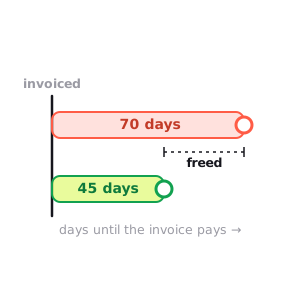
Here's the most expensive money in your business: the money you've already earned. You did the work, you shipped the invoice, the sale is on your P&L — and the cash is sitting in someone else's bank account, earning them interest instead of you. Every day it stays there is a day you're financing your customer's business out of your own.
The number that measures it is DSO — days sales outstanding: on average, how many days a sale waits as an unpaid invoice before it turns back into cash. It's the fastest-moving leg of the cash conversion cycle, and for a services or software business with no inventory, it's essentially the whole cycle. Good news: it's also the leg you control most directly — you set the terms, you send the invoice, you decide when to follow up.
Measuring it: what DSO actually is
DSO converts your unpaid invoices into a number of days. Take what's owed to you, divide by a day's worth of sales:
DSO = accounts receivable ÷ revenue × days in the periodWe'll run one business the whole way down: a commercial landscaping company doing $2.4M a year, with $460,000 tied up in receivables at any given moment. That's $460,000 ÷ $2.4M × 365 ≈ 70 days. The invoices say net-30. The customers pay in 70. That 40-day gap between the terms you set and the cash you see is the entire problem, in one number.
| Building the number | Value | |
|---|---|---|
| Accounts receivable | $460,000 | owed to you right now |
| Annual revenue | $2,400,000 | |
| Revenue per day | $6,575 | $2.4M ÷ 365 |
| = Days sales outstanding | 70 days | $460k ÷ $6,575 |
| Stated terms | 30 days | the gap is 40 days |
One caution before you compare yourself to anyone: a "good" DSO depends on your terms and your industry. A shop that's cash-at-the-till runs a DSO near zero; a business that sells net-60 to enterprise buyers can't. The useful comparison isn't against a benchmark — it's against your own terms and last quarter. If you invoice net-30 and your DSO is 70, the number isn't telling you the market is slow. It's telling you nobody's enforcing net-30.
Every day is real money
DSO stops feeling abstract the moment you price a single day. One day of DSO is worth one day of revenue — $6,575 for our landscaper. So every day you shave off the average isn't a rounding error; it's cash pulled back into your account, once and permanently, with no new sale required.
Work the terms-to-reality gap back down from 70 days to 45 — still generous, still fifteen days past net-30 — and you free 25 × $6,575 ≈ $164,000. That's a line of credit you don't have to draw, an owner's draw you can finally take, or payroll you stop sweating — funded entirely by money you had already earned.
DSO today
70days
40 days past terms
One day of DSO
$6.6k
≈ a day of revenue
Cut to 45 days →
$164k
Freed, no new sales
Enter annualized dollars — the day-count uses a 365-day year. Target DSO is the number of days you're aiming to get paid in.
70
DSO today
days to get paid
$6,575
One day of sales
revenue ÷ 365
25
Days you'd cut
today − target
Cash you'd free
$164,110
days cut × a day of sales
Cash tied up in receivables
$460,000
= 70 days of sales
There's a second, quieter cost. The longer an invoice ages, the less likely it is to ever be paid in full — 90-day balances turn into 120-day balances turn into write-offs. Cutting DSO isn't only about speed; it's about collecting the dollar at all.
The playbook: pulling DSO down without losing a customer
DSO is high for boring, fixable reasons — not because customers are villains. Almost every day you can recover lives in one of these, roughly in order of payoff:
- Invoice the day the work is done, not the end of the month. The clock only starts when the invoice lands. Billing on a monthly cycle quietly adds up to 30 days of DSO before a customer has done anything wrong. Send it same-day, itemized and correct — a disputed or vague invoice is one that sits in someone's "deal with later" pile.
- Take a deposit or bill in stages. For project work, a 30–50% deposit up front and progress billing along the way means you're never financing the whole job. This is the single biggest lever for contractors and agencies — it moves cash from after the work to during it.
- Make paying effortless. Put a pay link on the invoice. Accept ACH and card. Every extra step between the customer and "paid" — a check to cut, a portal to log into, an approver to chase — is days added to your DSO.
- Follow up on a schedule, before it's overdue. A polite reminder a few days before the due date, then a firm one the day after, then a phone call at day 15 — collects far more than a single angry email at day 60. Most late payments aren't refusals; they're invoices that fell behind a busier one. A steady cadence just keeps yours on top of the pile.
- Set terms you actually mean — and enforce them. Net-30 with a small early-pay discount (the classic 2/10 net 30 — 2% off if they pay in 10 days) can pull your best customers forward. A late fee in the contract, actually applied, does the same from the other side. Terms nobody enforces are just suggestions.
- Watch your biggest balances first. Collections is Pareto to the bone: a handful of accounts usually owe most of the money. Sort your aging report by balance, not by date, and spend your calls where the cash is. (If one customer is also a huge share of revenue, their payment habits are your cash flow.)
None of this requires being the bad guy. The businesses that get paid fastest aren't the most aggressive — they're the most consistent. Clear terms, instant invoices, easy payment, and a follow-up that arrives like clockwork train customers to pay you first, without a single hard conversation.
When DSO isn't your problem
If you're paid at the point of sale — a restaurant, a retail shop, a subscription that charges a card on day one — your DSO is already near zero and there's nothing to squeeze here. Your cash gets trapped somewhere else: in inventory on the shelf, not invoices in the mail. Don't force a collections project onto a business that already collects instantly — read the right leg of the cycle for how you actually get paid. But if you invoice and wait, DSO is usually the cheapest cash in the building, and almost nobody is working it.
See what a report like this looks like on your own numbers.
Meet your AI CFO →Prefer to run the numbers yourself? Try the free 13-Week Cash Flow Forecast — no signup needed.