The cash conversion cycle: how many days is your cash actually trapped?
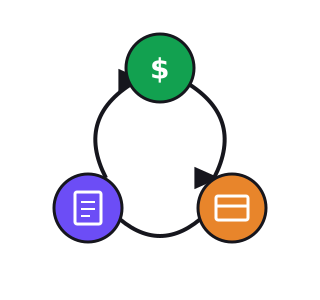
There's a gap that catches every growing business off guard: you're profitable on paper, but the bank account is always tight. The gap has a name. Every dollar you spend takes a lap — out the door to buy inventory, into a sale, into an invoice, and finally back to you as cash. The cash conversion cycle counts how many days that lap takes.
It's the companion to working capital: working capital is the dollar amount tied up in the business; the cash conversion cycle is the clock — how long it stays tied up. And the clock is where the cash hides.
The loop, in one line
Cash → inventory → a sale → a receivable → cash again. The longer that loop runs, the more cash sits inside it funding the next turn — and the more you borrow, draw on a line, or lean on suppliers to bridge the gap. Three numbers measure the legs, all in days:
- DIO — days inventory outstanding: how long stock sits on the shelf before it sells.
- DSO — days sales outstanding: how long a sale waits as an unpaid invoice before you collect it.
- DPO — days payable outstanding: how long you take to pay your suppliers, which floats part of the loop for free and shortens the cycle.
Add the two you fund and subtract the one your suppliers fund: CCC = DIO + DSO − DPO.
| Days | What it measures | |
|---|---|---|
| Days inventory outstanding | 119 | Stock waiting to sell |
| Days sales outstanding | 61 | Invoices waiting to be paid |
| less: Days payable outstanding | −42 | Supplier float you keep |
| Cash conversion cycle | 138 | Days your cash is tied up |
Why the number matters
A 138-day cycle means more than four months pass between paying for something and getting that cash back. You finance that gap the whole time — with your own cash, a line of credit, or by stretching the people you owe. So the cash conversion cycle is, in plain days, how much working capital your business demands just to operate.
Here's the part that bites during growth: a longer cycle scales with you. Grow revenue 30% while the cycle stays at 138 days and you need roughly 30% more cash permanently parked in inventory and receivables just to stand still. That's the mechanism behind the oldest surprise in business — a profitable company running out of cash. (It's the same profit-vs-cash gap behind the three layers of a CFO.)
Every day is real money
Translate the days into dollars and the cycle stops being abstract. One day of the cycle is worth roughly one day of revenue. At $5.7M a year that's about $15,700 a day — so shaving 20 days off the cycle frees roughly $314,000, once and for good, without selling anything more. That's usually faster and cheaper than squeezing another point of margin out of the P&L.
Cash tied up
138days
DIO + DSO − DPO
One day of cycle
$15.7k
≈ a day of revenue
Cut 20 days →
$314k
Freed, no new sales
Free · no account · no card
Get your 2027 budget built from your QuickBooks — P&L, balance sheet and cash flow, in Excel.
Which leg to pull
- DSO too high? Your customers are using you as a bank. Invoice the day the work ships, tighten terms, and call your biggest open balances at day 45 — not day 90. (Your aging report tells you exactly who.)
- DIO too high? That's cash sitting on the shelf. It's usually the biggest lever: trim the slow movers, order tighter and more often, and stop pre-buying working capital you won't sell for months.
- DPO too short? Paying early gives away free financing. Pay on terms, not ahead of them — unless there's an early-pay discount worth more than the float. Stretch too far, though, and you spend goodwill you'll want later.
The craft is shortening DIO and DSO without stocking out or strong-arming customers, and holding DPO steady without burning suppliers. Small, durable moves on each leg compound into months of cash.
When the cycle doesn't apply
Not every business has one. A services or software company holds little or no inventory and has almost no cost of goods — so DIO and DPO barely exist, and the "cycle" collapses to just DSO: how fast you turn a sale into cash. That's the right read for those businesses, and forcing inventory math onto them produces nonsense. It's why Wauvel only shows the full cash conversion cycle for businesses that actually move goods, and DSO on its own for everyone else.
Need your financials for a lender, a buyer or your accountant? Get the free financials pack →
See what an AI CFO says about your own numbers.
$99/mo, everything included. Free for 14 days, no card.
Prefer to run the numbers yourself? Try the free 13-Week Cash Flow Forecast — it’s free.