The 13-week cash flow: the quarter you can actually see
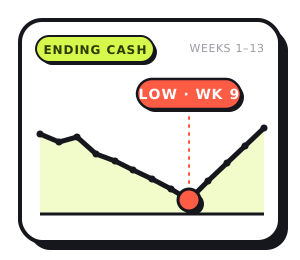
Every owner has had the 11pm version of the same thought: are we going to have the cash? Not last month's profit — the actual money, in the actual account, when payroll actually runs. Your P&L can't answer that; it looks backward. The 13-week cash flow can, because it's the one view that looks forward.
It's the forecast a CFO reaches for first in any cash-tight moment, and the one most small businesses don't keep — not because it's hard to understand, but because it's a chore to maintain. That's a fixable problem. Here's what it is, why thirteen weeks, and what changes when it's a click away.
What a 13-week cash flow actually is
It's a simple chain, run weekly for a quarter: start with the cash you have, add what you expect to collect, subtract what you expect to pay, carry the result into next week. Thirteen times.
| Line | Wk 1 | Wk 2 | Wk 3 | Wk 4 |
|---|---|---|---|---|
| Beginning cash | $50,000 | $48,000 | $46,500 | $44,500 |
| Cash in | $45,000 | $48,500 | $45,000 | $49,000 |
| Cash out | −$47,000 | −$50,000 | −$47,000 | −$53,000 |
| Ending cash | $48,000 | $46,500 | $44,500 | $40,500 |
That's the whole engine — no accrual cleverness, no theory, just the bank account projected forward. The power isn't in any single week; it's in watching the ending balance walk across the quarter.
Why thirteen weeks?
A quarter is the sweet spot. Far enough out that you can still do something — move a payment, chase an invoice, line up credit, delay a hire — and near enough that the numbers are real: you mostly know what's landing and what's due over the next three months. Twelve months is a guess; next week is too late. Thirteen weeks is the horizon you can both see and steer.
The one number it gives you
The headline isn't today's balance or where you land at the end of the quarter — it's the low point in between, and the week it lands. That's the number a snapshot can never show you: you can look perfectly solvent today and still walk through a Tuesday in week nine where the account scrapes bottom.
Ending cash · week 13
$31,000
Below where you started
Lowest point · week 9
$24,000
The week you'd feel it
Net over 13 weeks
−$19,000
More out than in
Profit is an opinion about the period; cash is a fact about the bank account — and the 13-week forecast is where that fact shows up before it bites. (More on that gap in the three layers of a CFO.)
Free · no account · no card
Get your 2027 budget built from your QuickBooks — P&L, balance sheet and cash flow, in Excel.
What having it at your fingertips changes
A forecast you rebuild once a quarter is a fire drill. A forecast you can pull up in two minutes is a decision tool. When it's right there:
- You time the big calls. A hire, a bulk order, a piece of equipment — slot it into a week you can actually afford, instead of hoping.
- You catch the squeeze early. See week nine coming back in week two and you have options — pull a receivable in, push a payment out, draw the credit line on your terms.
- You negotiate from strength. The financing conversation goes better in week two than in the week you're actually short.
- You answer on the spot. "Can we afford this?" stops being a feeling and becomes a number you can check before you reply.
- You sleep. Runway you can count in weeks is the cure for the 11pm thought.
Why most owners skip it — and the two-minute fix
The 13-week cash flow has a reputation as a finance-team artifact: a fiddly spreadsheet someone has to build and babysit. So most owners skip it until a crunch forces the issue — which is exactly the wrong time to start. The concept was never the barrier; the upkeep was.
So we built a free one you can use right now — no account, no setup. Type in your starting cash and your weekly ins and outs, add your own line items, and it draws the curve and flags your lowest week as you go. When you want to keep it, download it as a real Excel model with the formulas already in.
Need your financials for a lender, a buyer or your accountant? Get the free financials pack →
See what an AI CFO says about your own numbers.
$99/mo, everything included. Free for 14 days, no card.
Prefer to run the numbers yourself? Try the free 13-Week Cash Flow Forecast — it’s free.