Gross margin: what belongs in COGS (and what doesn't)
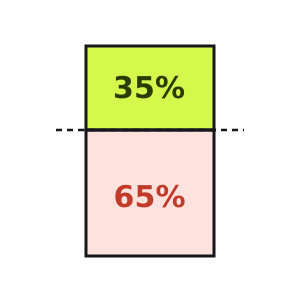
Two bakeries did $480,000 last year. Same city, same product, same costs to the dollar. One reports a 35% gross margin. The other reports 71%. Neither is lying, and neither made a single different business decision. The only thing that differs is where their bookkeepers filed the flour, the delivery driver, and the card processing fees.
Gross margin is the most quoted number in small-business finance and the most casually assembled. It drives your pricing, your break-even point, and every benchmark you compare yourself against — and it is entirely at the mercy of one judgment call: what counts as cost of goods sold. Get that line in the right place and the number tells you something. Get it wrong and you are comparing yourself to an industry average that uses a different definition of the word.
What COGS actually means
Forget the account names for a second. One question settles almost every case: if you sold one fewer unit — one fewer cake, one fewer job, one fewer subscription — would this cost go away? If yes, it is cost of goods sold. If the cost shows up whether you sell a hundred units or zero, it is an operating expense.
Flour goes away. Rent does not. The baker's hourly wage goes away if there is nothing to bake; the bookkeeper's retainer does not. That single test — does this cost follow the sale — separates the two halves of your income statement, and it is the reason gross margin means anything at all. Gross profit is what is left to run the company after you have paid for the thing you actually sold.
Revenue
$480k
what customers paid
Cost of goods sold
$312k
costs that follow the sale
Gross margin
35%
$168k to cover everything else
The four costs almost everyone misclassifies
Most of the confusion collapses onto the same handful of line items. Here is where each one belongs, and why:
- Shipping you pay to deliver. Freight out is COGS — no order, no shipping label. Freight in (what you paid to get inventory into your warehouse) is COGS too, but it belongs inside the cost of the inventory itself, not as its own expense.
- Payment processing fees. The 2.9% + 30¢ a processor takes only exists because a sale happened. It is COGS. Parking it in "bank fees" under operating expenses is the most common margin distortion in online businesses.
- Payroll — but only some of it. Split it. The people who make the thing or deliver the service are direct labor and belong in COGS. The people who run the company — admin, sales, finance, you — are operating expenses. One payroll account for everyone makes gross margin meaningless.
- Software. Ask the test. Your hosting bill scales with customers, so it is COGS. Your accounting software costs the same at zero customers, so it is opex. Plenty of software businesses get this backwards and report a margin ten points off.
| Classified properly | All costs in opex | |
|---|---|---|
| Revenue | $480,000 | $480,000 |
| Ingredients and packaging | $204,000 | — |
| Bakers' wages | $84,000 | — |
| Card processing fees | $14,000 | — |
| Delivery and freight out | $10,000 | — |
| = Gross profit | $168,000 | $480,000 |
| Gross margin | 35% | 100% |
| Operating expenses | $139,000 | $451,000 |
| = Net income | $29,000 | $29,000 |
Free · no account · no card
Get your 2027 budget built from your QuickBooks — P&L, balance sheet and cash flow, in Excel.
Why the line matters more than the number
A wrong gross margin does not just look bad on a report. It feeds four decisions you make with real money:
- Pricing. If you think you keep 71 cents on the dollar, a 10% discount feels cheap. If you actually keep 35 cents, that same discount just gave away 29% of your gross profit.
- Break-even. Break-even is fixed costs divided by contribution margin. Inflate the margin and you will calculate a break-even point you are nowhere near hitting.
- Benchmarking. "Restaurants run 65–70% gross margin" assumes food and kitchen labor are both in COGS. Compare your food-only number against it and you will conclude you are a genius.
- Hiring and spending. Gross profit is the pool every fixed cost gets paid from. Overstate it and every affordability question you ask gets the wrong answer.
Draw the line once, then stop moving it
There is no universal right answer for every edge case, and accountants genuinely disagree about a few of them. What matters far more than picking the theoretically perfect classification is picking one and holding it. A margin defined slightly unconventionally but measured the same way every month still tells you the truth about direction. A margin whose definition quietly drifts as costs get filed by whoever is doing the books that week tells you nothing at all.
Write your rule down. Two sentences is enough: what goes in COGS, what does not, and how payroll splits. Then check your last three months against it — misfiled costs tend to repeat, so one pass usually fixes the pattern rather than a single entry.
Need your financials for a lender, a buyer or your accountant? Get the free financials pack →
See what an AI CFO says about your own numbers.
$99/mo, everything included. Free for 14 days, no card.
Prefer to run the numbers yourself? Try the free Unit Economics Calculator — it’s free.